Ken's Second Act
I fear Arizona could become one-party rule like Texas after November

Texas politicians and boosters promote the state as being open to business with less government regulation and no state income tax. The attraction of jobs and other factors spurred population growth, helping to make Texas the second most populous state in America. California is the only state with more people.
When U.S. Sen. John Cornyn was running for re-election six years ago, he said during a debate with his Democratic challenger than he wanted the rest of America to be more like Texas. He lost in the Republican runoff Tuesday to Attorney General Ken Paxton, apparently because Cornyn wasn’t loyal enough to President Donald Trump.
Well, I’m a California native who doesn’t want his adopted state of Arizona to become more like Texas. The Texas economic miracle is a mirage in a state where the minimum wage remains the federal rate of only $7.25 an hour. By contrast, it is $15.15 an hour in Arizona.
What hurts Texas is it is a one-party rule in which a Democrat has not won a statewide office since 1994. With power comes arrogance and corruption. Gov. Greg Abbott has rammed through mid-decade reapportionment at Trump’s request – enabling Republicans to gain more seats in Congress – and school vouchers that even some state lawmakers from his own party in rural Texas opposed. He also signed one of the most restrictive abortion laws in the country. Abbott’s Costello, Lt. Gov. Dan Patrick, calls himself a Christian first, conservative second and Republican third. Patrick has been openly dismissive of big cities in the state that elected Democratic mayors.
By contrast, Arizona has a Democratic governor (Katie Hobbs), attorney general (Kris Mayes) and secretary of state (Adrian Fontes), and they serve as a bulwark against a right-wing, Republican-dominated state Legislature. Both senators, Mark Kelly and Rubem Gallego, are Democrats and have challenged the Trump administration, with Kelly taking on Secretary of War Pete Hegseth. Hobbs has vowed to veto any GOP-backed bill that doesn’t have bipartisan support. Mayes has led efforts by Democratic state attorneys general to sue the Trump administration and has challenged the state’s Republican superintendent of schools, Tom Horne. Fontes has resisted efforts by the U.S. Department of Justice to turn over the state’s voter registration list and prevailed in court
Divided government can create gridlock, but gridlock is better than the alternative of bad public policy and legislation, such as the One Big Ugly Bill at the national level.
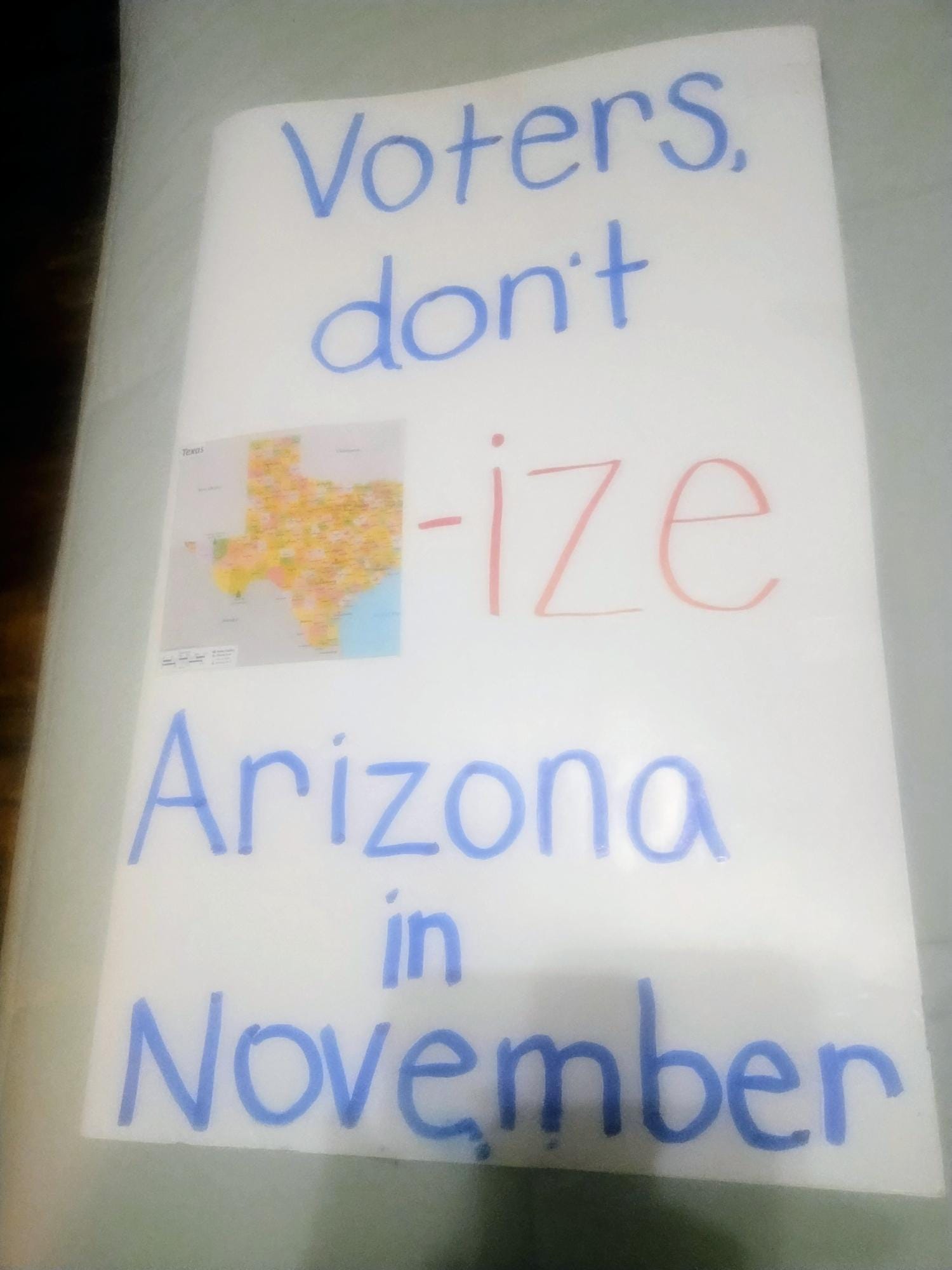
With that thought in mind, I came up with a message for a placard that I held during a Prescott Indivisible protest March 28 in Prescott Valley: “Voters, don’t (a map of Texas) -ize in Arizona in November.” The message is a takeoff on California bashing that has been going on for decades. I recall “Don’t Californicate Oregon” bumper stickers in the 1970s. My friend Jill designed the sign and stood next to me at the protest. (She is a private person and requested that I not post a photo of us.)
I shared a photo of the placard with my friend Melissa in East Texas. She messaged back that she loved it. I gained the perspective from living in Longview, Texas, for four and a half years and working as a reporter for all but three months of the time at the Longview News-Journal. While I retired and have been gone for nearly six years, I continue to follow Texas politics.
Recent press coverage and commentary don’t create a pretty picture of the Lone Star State. The Texas Tribune, a nonprofit online news organization, reported Paxton’s victory shows the tyranny of a one-party state: “Once led by chamber of commerce conservatives who preached small government and big business, the Texas Republican Party has been conquered over the last 15 years by a hard-charging, uncompromisingly conservative faction, operating on the vanguard of the nation’s culture wars and driven by a sense of perpetual insurgency.”
Fellow Substack blogger Paulo Santos posted the following in February:
“For roughly three decades, Texas has functioned as a one-party state at the statewide level. Republicans have controlled the governor’s mansion, the legislature, the statewide executive offices, and the judiciary for most of that period. The policy record is not ambiguous. The fingerprints are everywhere.
“And yet, when the power grid collapses, when maternal mortality rates spike, when rural hospitals shut down, when public schools struggle for funding, a familiar refrain echoes across the political landscape:
“This is the Democrats’ fault.”
I don’t see polling data and lack a crystal ball to predict the outcome of the midterm general election Nov. 3 in Arizona. Mayes, who grew up in Prescott, won her bid for attorney general in 2022 by only 280 votes and has been fundraising since then. Arizonans are lucky to have her as attorney general instead of the scandal-plagued Paxton in Texas. Republican challengers are likely to pledge fealty to Trump. For example, outgoing U.S. Rep. Andy Biggs, Hobbs’ likely opponent in November, challenged the certification of electoral votes in Arizona and Pennsylvania for former President Joe Biden in 2021 and has been endorsed by Turning Point USA, a right-wing political cult.
So, I hope voters heed my message and follow the T-shirt advice from my gay friend Hank in Longview: “Legalize reason.” I gave my Texas license plates to my friend, Chris, who vowed to hang them upside down until the Lone Star State turns purple or blue. Sadly, I don’t foresee any major change there in November.
The Chalie Daniels Band once sang the lyric, “People in Texas don’t care if the sun don’t shine.” They can’t see the sun if dust and smog block the sun’s rays. Let’s hope the political climate remains sunny in Arizona after November.
Ken, you had me at your reference to "Legalize reason."
That says it all!
I really hope that Talarico has the votes to win over Paxton.